





What a mini split tune-up covers in Massachusetts

Step 1 of 3: Equipment

A mini split tune-up means a contractor cleans the indoor unit's filters and coil, checks the outdoor condenser for dirt and debris, clears the condensate drain, and checks the refrigerant charge and the electrical connections. The indoor filters matter most in Massachusetts, since the same unit that cools your house through a sticky summer is often what heats it in the winter, and a dirty filter makes it work harder both ways. The outdoor unit gets checked for ice or blockage too, since a heat pump running in cold weather can build up frost that cuts its output. Skip this and the system loses efficiency slowly, so you may not notice until a bill comes in high or a room stops holding temperature. A yearly tune-up catches that drift early, before a clogged coil or a low charge turns into a breakdown on the coldest or hottest week of the year.

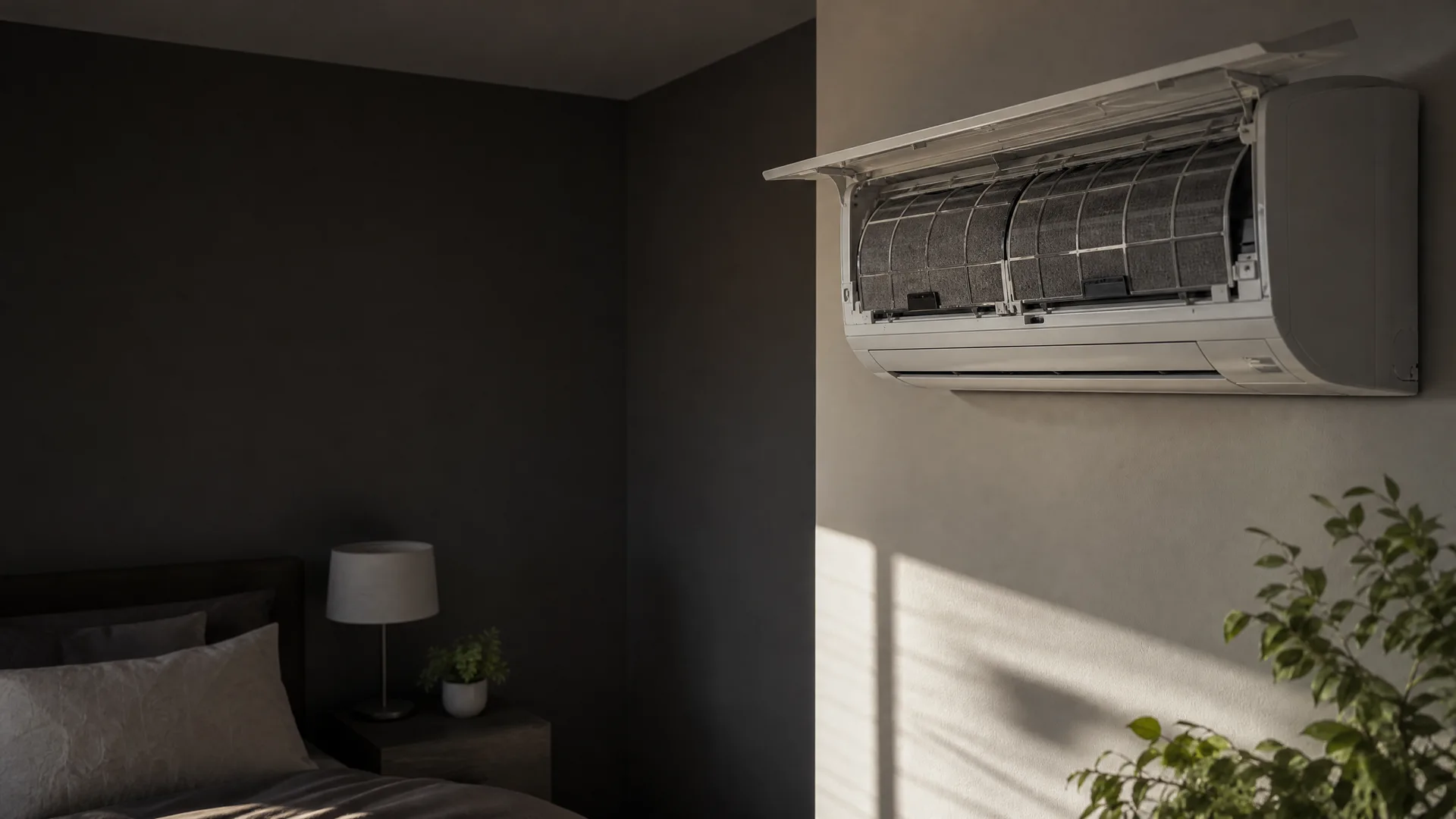
A wall-mounted mini-split air conditioner with its front cover open exposing the filters, in a dim bedroom with a bed, nightstand lamp and a potted plant.

You pop the front cover off the bedroom unit to see why the air feels thinner than it used to. It's a mild spring afternoon, the kind where you haven't needed the mini split much the past week or two. The filter screen slides out grey with a season's worth of dust, more than you expected. Light from the window catches the dust still hanging in the air after you pull it loose. You think back to last August, the unit running most nights just to keep the room livable, and wonder how much of that strain came from air trying to push through a screen this clogged. Outside, the condenser sits on its pad, quiet for now, waiting for the heat to come back.

A white wall-mounted mini-split air conditioner installed high on a beige interior wall near the ceiling molding, with a light curtain and curtain rod at the left edge.
A clean mini split like this one moves air without straining, so it holds the room's temperature on a muggy August night without running longer than it should.
A wall-mounted mini-split air conditioner indoor unit with a discolored cream plastic casing and dusty outlet vanes, installed high on a plain light-colored interior wall near the ceiling.
A unit left dusty like this one restricts its own airflow, and the compressor outside works harder for the same cooling, which shows up on the bill.

A mini split tune-up goes past the filters most people clean themselves. Inside, the blower wheel collects dust between its fins, and that chokes airflow even with a fresh filter in place. Outside, the condenser coil gets rinsed from the back side first, since that's the side facing the wall or fence where dirt settles. The condensate line gets checked for algae, because a clog there is what sends water dripping out of the indoor unit onto your floor or wall. At the line set connections outside, a contractor looks for a loose flare fitting, which is where a slow refrigerant leak usually starts. The outdoor disconnect gets a check too. A loose wire at that connection is a common reason a mini split trips its breaker for no clear reason. And the thermostat or remote sensor gets tested against an actual thermometer, since a reading that's off by a few degrees keeps the compressor running longer than the room needs. Each of these is a specific point of failure, not a general wipe-down, and catching one early is usually what keeps a small problem from becoming a breaker trip or a wet floor in July.

What actually gets checked

  • A tune-up starts with the indoor unit's blower wheel, since dust packed between the fins cuts airflow even after the filters are clean.
  • The outdoor condenser coil gets rinsed from the inside out, because dirt builds up on the back side facing the wall or fence first.
  • A contractor checks the condensate pump or drain line for algae, since a clogged line is what causes water to drip from the indoor unit.
  • The refrigerant lines get checked at the line set connections outside, where a loose flare fitting is the most common spot for a slow leak.
  • Electrical connections at the outdoor disconnect get tightened, since a loose wire there is a common reason a mini split trips its breaker.
  • The thermostat sensor or remote's temperature reading gets checked against a thermometer, because a sensor reading a few degrees off runs the compressor longer than needed.
A smiling woman with dark shoulder-length hair in a cream V-neck sweater sits at a marble counter with a glass of red wine, with a kitchen and softly lit living room behind her.
A woman in a dark green sweater laughs while seated at a marble kitchen island with a glass of red wine, with open shelving, cabinets and a living room visible behind her.
A woman with long dark hair in a cream knit sweater laughs while looking off to the side, seated at a counter with a glass of red wine, in a dimly lit living room with a sofa, lamp, framed pictures and houseplant behind her.
A smiling woman with long dark hair in a beige sweater sits at a marble kitchen counter with a glass of red wine, with a dimly lit living room behind her.

Why the drain line matters here

A mini split pulls moisture out of the air all summer, and that water has to go somewhere. It runs down a condensate line to a drain, usually through a small pump inside the indoor unit. If algae or dust clogs that line, the water backs up and either shuts the unit off or drips down the wall it's mounted on. A tune-up clears that line before it's a problem, not after you've found a stain under the unit. In a humid Massachusetts summer, that line is working every day the system runs.


What a dirty coil does to your bill

The indoor coil is where the refrigerant actually pulls heat out of the room, and it can only do that if air passes through it freely. Dust packed into the coil fins makes the system run longer to reach the same temperature, which on Massachusetts electric rates shows up on the bill fast. It also means the compressor outside cycles more than it needs to, which wears on the part most expensive to replace. A coil cleaned at the start of the season avoids that extra runtime for the months you depend on it most.

A dusty white wall-mounted mini-split air conditioner installed high on a beige interior wall below a molded ceiling trim.
Before you get your mini split maintenance
A white wall-mounted mini-split air conditioner unit installed high on a light gray interior wall near the ceiling, with a white-framed window and green foliage visible at the left edge.
After you get your mini split maintenance

Skip the tune-up and the system still runs, right up until the day it doesn't. Dust keeps building on the coil, the drain line keeps narrowing, and the compressor outside keeps working harder to push air through a dirty filter.

Get it looked at once and a contractor finds the clogged drain before it backs up into the wall, finds the dirty coil before the compressor burns out trying to compensate. The system runs the way it's supposed to, and you're not the one who found the problem the hard way.

Power costs 30.41 cents per kilowatt-hour statewide

At 30.41 cents per kilowatt-hour, every extra minute your mini split runs to push air through a dirty filter shows up on the bill fast. A unit that's clean and charged right cools your room in less time, so it draws less power doing it.

EIA-861 2025 statewide residential average

A white wall-mounted mini-split air conditioner installed near the ceiling on a light-colored interior wall, with a window and green foliage visible at the left edge.

Clean and running right

This is what a mini split looks like when the filters and coil are clear. Air moves freely through the vents, the room holds its temperature, and the unit by the window isn't straining to keep up on a hot afternoon.

A dusty white wall-mounted mini-split air conditioner indoor unit installed high on a beige interior wall below a white ceiling and trim.

Clogged and overworked

Dust has built up across the vents and the intake grille. Air has to push through that buildup to reach the room, so the unit runs longer and the compressor outside works harder than it should have to.

A smiling bearded man in a navy crewneck sweater sits at a dinner table with a glass of red wine, plates and glasses in the foreground, in a dimly lit room with a lamp and framed picture behind him.
A woman in a dark gray sweater reclines on a light sofa with eyes closed and a slight smile, under a textured gray blanket with an open book resting on her lap, with a lit table lamp and plant in the background.

Skip calling around

You know the filter needs cleaning and the drain line needs checking. What you don't know is finding someone in Massachusetts who works on mini splits regularly, who'll answer the phone, and who can actually get to your place before the humidity makes the room unbearable again. The usual route means calling a few places, describing the unit over the phone, waiting on quotes, picking one. This page skips that. Fill out the request once and it goes to one licensed local contractor, someone who services this equipment all summer and knows what usually clogs or wears out on these units first. No sorting through five bids, no repeating yourself to each one. You still have to deal with a dusty coil and a slow drain line. You don't have to deal with finding who'll fix it.

  1. Pull the filters first and check how clogged they are.

  2. Slide out the indoor coil cover and inspect it for mold or dust.

  3. Rinse the indoor coil fins with water or a coil cleaner.

  4. Flush the condensate line to clear algae or sediment buildup.

Why does your mini split feel weaker than it used to

You notice it most on the muggy nights, when the room near the unit doesn't quite get cool and stays cool the way it did last summer. The air coming out feels thinner, maybe a little warm around the edges, even with the thermostat set the same as always. Sometimes there's a musty smell when it first kicks on, or a drip you can't place near the indoor unit. You might hear it running longer into the evening than it should, the compressor outside cycling on and off more than you remember. None of this means the unit is finished. It usually means the filters, coil, or drain line need attention before the strain on the compressor turns into something that actually breaks.

A two-story gray horizontal-siding house with multiple gables, a covered front porch with white columns and railing, and a dark front door, fronted by a patchy green and brown lawn under a clear blue sky.

A summer dew point averaging 60°F, per NOAA climate data, is the point where air starts feeling heavy instead of just warm. Your mini split isn't only lowering the temperature on nights like that, it's wringing water out of the air to get the room to feel right. That's the harder half of its job, and a dirty coil or a clogged filter slows it down right when you need it most. You'll notice it as a room that cools some but still feels damp, or a unit that runs long stretches without the air ever feeling crisp.

NASA POWER T2MDEW county cells weighted by homes

Finding Help vs. Getting Matched

Call around yourself

  • You'd be checking licenses one by one, since not every outfit that answers a mini split ad actually services them regularly.
  • Expect to explain the same thing to each company: which unit, which room, what it's doing, before anyone gives you a number.
  • Several contractors calling back means juggling return calls and texts while you're trying to get on with your evening.
  • You're left comparing quotes against each other without knowing if they even mean the same scope of work.
  • If the first one can't come until next month, you're back to searching and starting over.

Get matched here

  • One local contractor gets your request, so you're not fielding calls from four different companies at once.
  • Someone who works on mini splits all season in Massachusetts has likely already seen whatever's wrong with yours.
  • You describe the unit and the problem once, to the person who's actually going to look at it.
  • A contractor who knows the drain pumps and coil layouts common on these systems isn't guessing at the fix.
  • You get on a schedule instead of a search, which matters once the humidity starts making the room feel the way it does without maintenance.
A white wall-mounted mini-split air conditioner on a light gray wall in an empty room with dark wood flooring, white baseboards, a tray ceiling with recessed lights, and a window at the left.

Running the way it should

This is a mini split doing its job. The vents are clear, the wall unit sits clean against the molding, and the room holds whatever temperature you set it to. Nothing about it is straining to keep up.

A wall-mounted mini-split air conditioner indoor unit with a yellowed plastic casing and dark horizontal vent louvers, installed on a plain light-gray wall.

Dust on top, residue at the vents

Dust has settled on top of the unit and a dark residue rings the vents. Air still comes out, but less of it, and whatever's built up inside is making the compressor outside work harder than it should to cool the room.

A closed silver laptop and a ceramic mug of dark coffee sit on a wooden table in front of two chair backs, with a kitchen counter, tiled backsplash, wooden cutting boards, a vase of greenery and a potted plant by a window behind.

What a mini split tune-up covers, and where that leaves you

A tune-up covers the filters, the indoor coil, the condensate line, the outdoor condenser, and the refrigerant charge. That's the whole job. A contractor who knows mini splits goes through all five in one visit, so you're not left guessing which part is causing the room to run warm.

You could spend an evening calling around Massachusetts, asking each company if they even work on mini splits, then describing the unit and the room to every one of them before you get a price. Or you put in a request here and a local contractor who services this equipment all summer takes it from there, one call, not five.

Interior corner of a room with a window and sheer curtain at left, a gray upholstered sofa with a cushion at right, and a round wooden table holding stacked books and a round vase with an olive branch.
A white wall-mounted mini-split indoor unit on a light gray wall above a beige sectional sofa with a patterned cushion, beside a framed abstract artwork and a curtained window.

Describe it once

Skip calling around

Only one pro gets your request, so you hear from one company.

There's no charge for the request.