




What defrost mode means on a Massachusetts mini split

Step 1 of 3: Equipment

Defrost mode is your mini split pausing heat to melt ice off the outdoor unit. In Massachusetts winters, cold damp air makes frost build up on the outdoor coil, and ice there blocks airflow and stops the system from pulling in heat. So every so often the unit reverses itself for a few minutes, runs like an air conditioner to warm that coil, and sheds the ice. You might see the indoor fan slow down or stop, or steam rise off the outdoor unit. That's normal. It becomes a problem when defrost runs constantly, runs long, or the unit never comes back to heating afterward. That usually points to a stuck sensor, a failing reversing valve, or low refrigerant, not just cold weather doing its job.

A white wall-mounted mini-split air conditioner near the ceiling of a room with plain beige walls and a pale curtain at the left edge.

What happens during the cycle

The outdoor fan stops and the system briefly reverses, sending warm refrigerant through the outdoor coil instead of the indoor one. That warms the coil enough to melt the frost off it. You might see steam or water coming off the outdoor unit during this, and that's normal. Indoors, the air handler may pause or blow cool air for a few minutes, and the room doesn't lose the heat it already has.

A white wall-mounted mini-split air conditioner indoor unit installed near the ceiling on a plain off-white interior wall.

Why it runs more some nights

Frost builds up faster when the air outside is cold and damp at the same time, which is common in Massachusetts from December through February. On those nights a mini split may run defrost every half hour or so instead of every few hours. If it's running defrost far more than that, or the outdoor unit stays iced over after a cycle, something in the system isn't clearing the frost the way it should.

Normal Defrost or a Problem?

Normal defrost

  • The indoor unit's fan usually stops or slows to a trickle so it isn't blowing cold air into the room while the system is reversed.
  • A defrost light or snowflake icon on the indoor unit or remote often comes on to tell you what's happening.
  • The cycle runs for a few minutes at a time and the system goes back to heating on its own once the coil is clear.
  • Steam or water coming off the outdoor unit during this time is the melted frost, not a leak.
  • It happens more often on the coldest, dampest days because that's when frost builds fastest on the outdoor coil.
  • The room stays roughly at temperature through a normal cycle since the pause is short.

Something's wrong

  • The outdoor unit is caked in a thick layer of ice or snow that never seems to clear, even after several defrost cycles.
  • The system goes into defrost very often, sometimes every few minutes instead of occasionally during the coldest stretches.
  • The indoor unit blows noticeably cold air for a long stretch instead of pausing briefly during defrost.
  • The outdoor fan isn't spinning at all, even though the unit is drawing power and trying to run.
  • Rooms take much longer than usual to warm up, or one stays cold no matter how long the system runs.
  • A low hum or a sensor fault code shows up on the indoor display instead of the normal defrost signal.
A smiling man in a gray long-sleeved shirt stands in a kitchen looking to the side, with open shelves of dishes, a white mug on the counter, a potted plant, and a view through a doorway into a living room.
A smiling bearded man in a green sweater sits at a white marble kitchen island with a mug, potted plant and bowl of fruit, in a bright white interior with open shelving and an arched doorway.
A smiling man with dark curly hair and a beard, wearing a dark green knit sweater, stands at a white marble kitchen counter with a dark blue mug, with open shelving, pendant lights and a houseplant behind him.
A smiling man in a green ribbed sweater stands behind a wooden table holding a ceramic mug of coffee in a kitchen with white subway tile, shelves of potted plants, and a bowl of fruit.

How long does defrost mode last on a mini split?

You've noticed your mini split go quiet, maybe seen steam rising off the outdoor unit, and you're standing there waiting for it to switch back. With power rates in Massachusetts what they are, every minute the system spends not heating feels like it's costing you something, and you want to know whether this is normal or whether it's stuck.

Most defrost cycles run 5 to 15 minutes

A normal defrost cycle finishes in 5 to 15 minutes once the outdoor coil is clear of ice, then the system switches back to heating on its own. How often it happens depends on the weather. On a damp, near-freezing day, which Massachusetts gets plenty of from December through February, you might see it kick in every 30 to 90 minutes. If you time it and the outdoor unit sits idle well past 15 minutes, or the indoor fan never comes back on, that's not a normal defrost cycle anymore. At that point something is keeping the system from reversing back to heat mode, and it's worth having a contractor look at before a short pause turns into a system that won't heat the house at all.

A white wall-mounted mini-split air conditioner installed high on a beige interior wall near the ceiling, with a white-framed window at the left edge.

Normal defrost cycle

The indoor unit sits quiet for a few minutes, fan off or barely moving, while the outdoor unit clears frost off its coil. The snowflake icon comes on, then goes off, and heat picks back up on its own. No smell, no noise that worries you, nothing left behind on the wall unit.


A dusty, stained wall-mounted mini-split air conditioner indoor unit near the ceiling on a plain beige wall, with visible lint buildup at its intake grille.

Something's wrong

Dust and dark streaks mean air isn't moving through that coil the way it should, so frost builds faster and defrost runs more often than it needs to. Grime like this holds moisture against the unit between cycles, which is how mold gets started on a coil that's supposed to dry out.

A closed dark laptop and a ceramic mug of coffee on a wooden dining table, with wooden chairs, a dark kitchen cabinet with cutting boards and a potted plant, and a leafy plant by a window in the background.

What a stuck defrost cycle costs you in your own house

If defrost mode won't let go, your living room stays cold while the outdoor unit runs and runs. You'll notice the room not warming back up the way it should, maybe a draft of cold air blowing in when the indoor fan kicks back on wrong. Meanwhile the outdoor unit is pulling power the whole time it's stuck, and on Massachusetts electric rates that adds up fast on a system that's supposed to be an efficient backup, not your main heat fighting itself all night.

Most homes around here heat with gas, so your mini split is likely doing one room or a few, covering the gap the furnace doesn't reach well. When it's stuck in defrost, that gap goes cold and stays cold. You could spend an evening searching for who even works on mini splits in your town, calling a few numbers, explaining the icon and the icing and the cold air all over again to each one, then sitting with quotes trying to guess which contractor actually knows this equipment. Send the form instead and that part of it is off your plate.

Interior corner with a beige sofa holding a dark green and a light cushion and a textured throw, a potted small-leaved tree beside a white-framed window, and a dark shallow bowl on a wooden coffee table in the foreground.
  1. A sensor reads the outdoor coil temperature and spots ice forming.

  2. The reversing valve flips, sending hot refrigerant outside instead of in.

  3. The outdoor fan shuts off so heat stays on the coil.

  4. Heat melts the frost, and water or steam drains off the unit.

A smiling man with dark curly hair in a navy t-shirt sits on a gray couch indoors, with a large-leafed plant and a window in the background.
A bearded man in a plaid flannel shirt stands in a kitchen looking out a window toward snow-covered shrubs, with a steaming mug on the windowsill and potted plants on a shelf behind him.

Hand off the mini split problem

Answer a few questions instead of calling shop after shop.

Sending the form costs nothing.

A single-story house with gray vinyl siding, dark shingled gable roofs, and white-trimmed windows, set behind a partly dry green lawn under a clear blue sky.

Summer humidity here isn't just about the heat index. Averaged across Massachusetts homes, the dew point runs 60°F over June, July and August, per NOAA climate data. That's the number that makes the air feel heavy even on a day that isn't that hot. For your mini split, that means the indoor coil is pulling moisture out of the air almost nonstop, not just cooling it. A unit that's low on refrigerant or has a dirty coil struggles more with that load, and you'll notice it as a room that feels cool but still sticky, or a system that runs long stretches without the house ever feeling dry.

NASA POWER T2MDEW county cells weighted by homes

Why does my living room feel cold when the unit is running

You're sitting under the indoor unit and no warm air is coming out, even though the power light is on. The fan might be dead quiet, or you might catch a cold draft for a second before it stops. Outside, you'd see the fan not spinning and maybe some steam or dripping around the base. A few minutes of that is normal on a cold Massachusetts night. If it stretches past ten or fifteen minutes, or if it happens over and over through the evening, the room won't hold heat and the unit keeps pulling power without warming anything. Left alone through a full winter, that pattern runs up your electric bill for heat you never actually get.

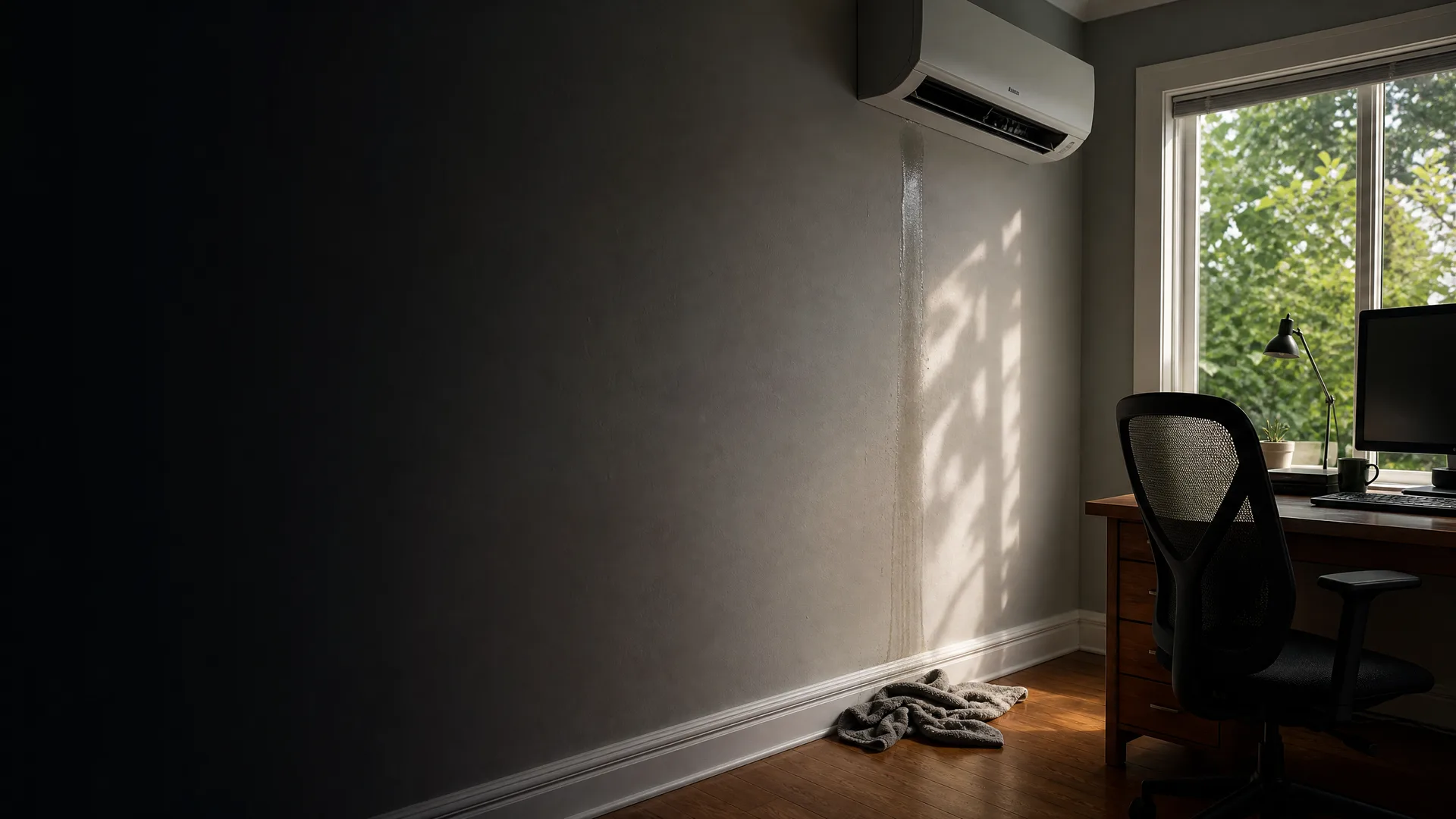
A wall-mounted mini-split air conditioner in a dim room, with a water streak running down the wall below it to a towel on the floor near the baseboard, beside a desk, office chair and monitor by a window.

It's a July afternoon and you're at the desk in the home office, mini split running to keep the room livable against the heat outside. You notice the wall under the indoor unit looks dark. A streak, running down from the unit toward the baseboard. You get up to look closer and there's water on the floor too, enough that you go grab a towel and lay it down before it reaches the rug. The unit is still blowing cold air, humming along like nothing's wrong. You stand there for a second, towel under your foot, trying to figure out where the water's coming from.

Power costs 30.41 cents per kilowatt-hour statewide

At 30.41 cents per kilowatt-hour, every cycle your mini split runs outside its normal defrost pattern shows up on the bill fast. A unit stuck defrosting too often, or too long, is pulling power without giving you heat back, and in Massachusetts that waste costs more than it would almost anywhere else.

EIA-861 2025 statewide residential average

A white wall-mounted mini-split air conditioner indoor unit installed near a textured ceiling on a plain beige wall, with visible dust and discoloration on its casing and vent.
Before you get your mini split repair
A white wall-mounted mini-split air conditioner indoor unit on a light gray wall above a white baseboard and wood-look floor.
After you get your mini split repair

Knowing the difference matters

  • Defrost mode is the system melting ice off the outdoor coil, not a malfunction on its own.
  • A normal cycle ends on its own in a few minutes, with heat picking back up without you doing anything.
  • A cycle that drags on, repeats too often, or never lets heat return points to a problem a contractor needs to look at.
  • A stuck defrost cycle keeps pulling power while your living room sits cold, and at 30.41 cents per kilowatt-hour that adds up fast.
  • Catching it now means skipping the part where you search for contractors, call around, and explain the same problem more than once.
  • Sending the form hands off the search for help, not the repair itself, so that part stops being your problem to manage.

Defrost mode is the system clearing ice off the outdoor coil so it can keep pulling in heat. That's normal, and it's not a sign anything is wrong, as long as it ends on its own after a few minutes and your living room goes back to warming up without any help from you. What's not normal is a cycle that keeps repeating, runs long, or finishes and leaves the room cold anyway. That pattern means something inside the system isn't resetting the way it should, and it's not something to watch and wait on. Every cycle outside the normal pattern still pulls power, and at 30.41 cents per kilowatt-hour, a unit stuck defrosting too often is costing you for heat it isn't giving back. The part that takes the real time isn't the repair itself. It's finding someone who can actually look at it: searching for a contractor, calling a few, explaining the same thing about the steam and the cold draft more than once, then sorting through what each one quotes you. Sending the form skips that part. It doesn't make the repair faster or cheaper, but it means you're not the one doing the legwork to find someone who can do it. Once you've sent it, that search is off your plate, and what's left is waiting to hear back instead of working the phone yourself.

A dark wood cabinet with a paneled door and a ceramic pot of green foliage on top stands in a beige-walled room with white baseboard, a window at left, hardwood floor, and a patterned area rug.
A dark wood glass-front cabinet holding folded towels, woven baskets and a ceramic vase stands in a bathroom corner beside a window, with a potted fern and stacked towels on top and a freestanding tub partly visible at left.
A woven basket holding a green cushion and a cream fringed knit throw sits on a wood floor in a room corner beside a window and a dark wooden cabinet.
Corner of a room with a dark wood cabinet topped by a round vase, a linen curtain at a window, white baseboard, oak plank flooring with sunlight patches, and a woven jute rug in the foreground.
A dark wood sideboard against a pale wall holds a shallow stone bowl and a round ceramic vase with leafy branches, with sunlight from a curtained window falling across the wall, wood floor and woven rug.

Done looking for a mini split pro

Describe your mini split job once, to one pro.

Hand off my repair

You're not committing to anything by asking.